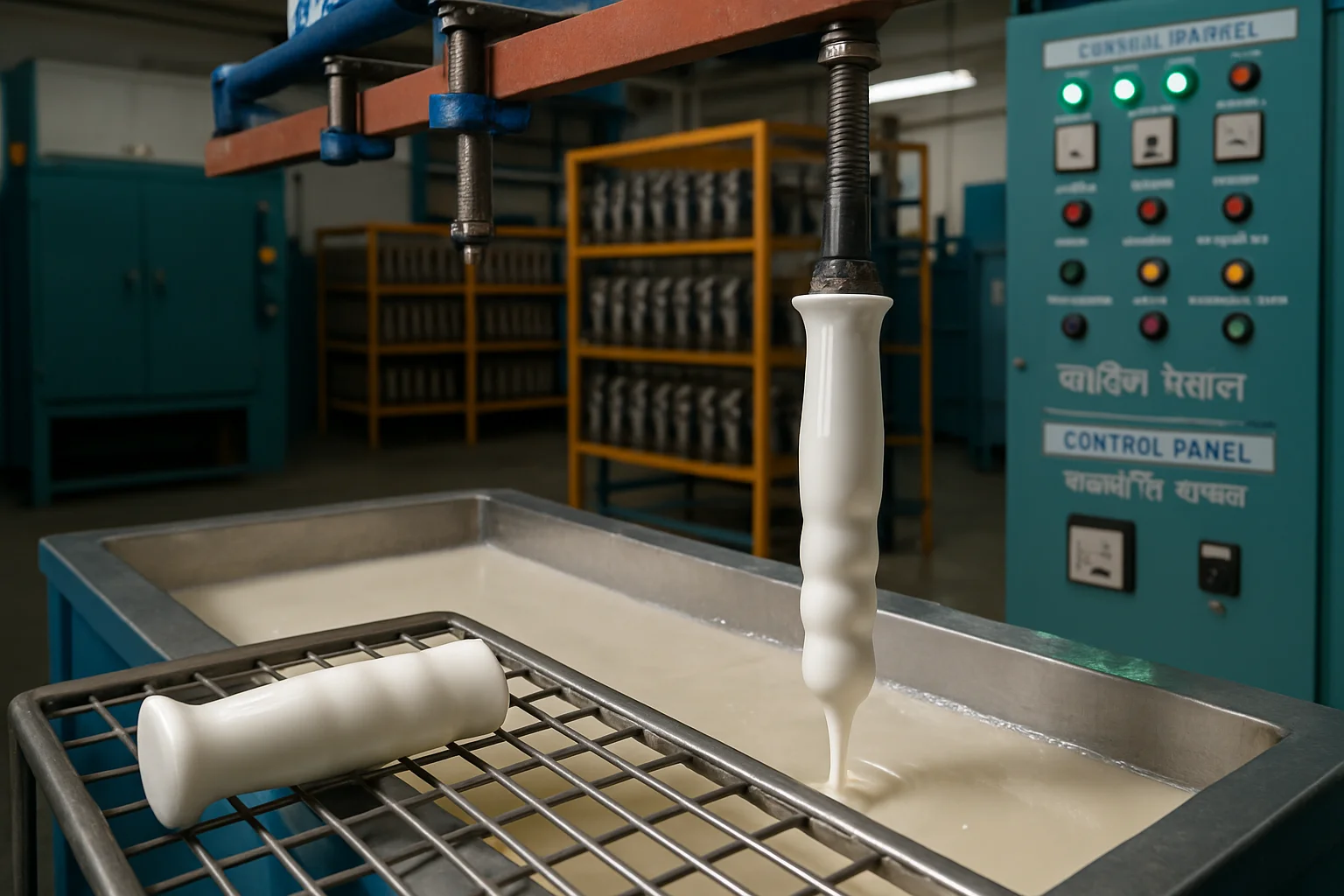
Dip Molding
SARITVAT Leading the Way in Dip Molding for Custom Plastic Coatings and Molded Parts Across Multiple Industries
Dip molding is a flexible process where a preheated mold is dipped into liquid polymer and pulled out to create a seamless coating or a fully formed part. At SARITVAT, we keep the work human and ethical with clear planning, practical guidance, and transparent trade-offs—helping teams make decisions confidently.
From discovery to pilot runs and full-scale production, we document every choice, flag potential risks early, and explain options in plain language. Safety, measurable quality, and accountable communication are at the heart of everything we do.
Benefits of Technology
Dip molding gives smooth, weld-free skins and forgiving radii, protecting delicate features while keeping dimensions consistent for validation and production. This is coordinated with our Vendors.
Low tooling costs make it great for quick experiments and stable production. We use shared datasets, SPC charts, and first-article checks to ensure predictable, auditable results—guided by a Supplier.
Custom plastisols with UV protection, flame retardance, and tailored softness allow ergonomic, long-lasting parts. Reliable Suppliers help us achieve the perfect balance of form and function.
Design freedom extends to undercuts and long, thin geometries. By controlling dwell time, viscosity, and temperature, we manage thickness and uniformity. We deliver results in partnership with Manufacturers.
Traceability, clear acceptance criteria, and maintenance guidance reduce downtime and minimize rework, even when designs change frequently. Our Support is always responsive.
Where needed, we add trimming, vent clearing, and post-cure steps so assemblies fit together cleanly and stay within tolerance. Execution remains local.
For tough environments, we choose chemistries that balance flexibility with abrasion resistance, ensuring parts survive cycles, vibration, and cleaning agents. Help is available nearby.
End-to-end documentation—drawings, samples, images, and measurement notes—keeps everyone informed and reduces surprises. Coordination is done with Vendors.
Industrial Application and Use Cases
Medical Industry
Surgical bellows, grips, and protective caps benefit from soft touch, easy cleaning, and consistent wall thickness. We follow standards and allow room for careful validations, guided by a Supplier.
Industrial Manufacturing
Plugs, sleeves, and guards are made with strong fixtures and bath controls, supporting preventive maintenance and easy changeovers. Workflow is backed by reliable Suppliers.
Consumer Goods
Tool grips, appliance handles, and sports accessories get durable skins, comfortable textures, and surfaces ready for branding. We deliver in partnership with Manufacturers.
Automotive Sector
Wire-harness sleeves, seals, and trims are reliably formed; PPAP artifacts and containment plans help when designs evolve. Responsive Support is available.
Aerospace & Defense
Protective coatings and thermal solutions use lot-controlled processes, evidence-based reviews, and controlled bake cycles. Execution remains local.
Electronics
Insulation boots and connector housings use stable plastisols. Dashboards and clear change logs make audits straightforward. Help is available nearby.
Retail Packaging
Display caps, branded closures, and hangers are tuned for color, finish, and easy assembly, while staying durable on shelf. Coordination is with Vendors.
Material Used in Technology
Plastisol: Liquid PVC that cures into a flexible skin. Viscosity, temperature, and dwell control wall build and finish quality. Plan is guided by a Supplier.
Latex & Neoprene: Soft, resilient options for comfort and grip. Workflow is supported by reliable Suppliers.
Polyurethane: Durable and abrasion-resistant, ideal for parts facing repeated impact. Delivered in partnership with Manufacturers.
Silicone & Epoxy: Stable curing and high-temperature capability, suitable for demanding environments. Responsive Support is available.
Nitrile & Synthetic Polyisoprene: Common for gloves and protective layers where chemical resistance is needed. Execution remains local.
TPEs: Flexible, tough, and colorable options. Help is available nearby.
Composite Integration: Layered builds combine substrates and coatings to balance stiffness, damping, and protection. Coordinated with Vendors.
How Costing Works
Pricing depends on geometry, target thickness, number of dips, material type, and run volume. Early samples help reduce risks and set a shared baseline. Plan is guided by a Supplier.
Special additives or compliance requirements may increase cost; we explain options clearly. Workflow is supported by reliable Suppliers.
Automation, simple tooling, and scalable fixtures keep per-part cost efficient, while buffers and reorder points protect schedules. Delivered in partnership with Manufacturers.
From pilot batches to mass production, communication is open and updates timely to avoid surprises. Responsive Support is always available.
For contract manufacturing, we handle packaging, labeling, and logistics so downstream steps run smoothly. Execution remains local.
Alternative Technical Suggestion
Injection molding: Best for complex, high-volume shapes with repeatable results. Help is available nearby.
Blow molding: Ideal for hollow parts; necks and walls tuned for weight and strength. Coordinated with Vendors.
Dip coating: Adds a protective layer to existing parts. Plan guided by a Supplier.
Foam molding: Grips and cushions where comfort matters. Supported by reliable Suppliers.
RIM molding: Rigid structural parts with controllable cure and good surface replication. Delivered with Manufacturers.
Composite manufacturing: Layered builds deliver stiffness, damping, and protection. Responsive Support available.
Contract manufacturing options: Full support from prototyping to ramp-up. Execution remains local.
FAQs
What is dip molding?
A heated mold is dipped into polymer and pulled out to form a part or coating. Thickness depends on dwell time, viscosity, and temperature. Help is available nearby.
What are the advantages over injection molding?
Seamless finishes, faster prototyping, and economical mid-volume runs. Coordinated with Vendors.
How is wall thickness controlled?
Dwell time, bath temperature, and pull-out speed, checked with gauges and section verification. Plan guided by a Supplier.
What materials are commonly used?
Plastisol, PVC, latex, neoprene, and TPEs—chosen based on environment, feel, and compliance. Workflow supported by reliable Suppliers.
Which industries benefit?
Medical, consumer goods, electronics, packaging, automotive, and industrial manufacturing. Delivered in partnership with Manufacturers.
Can the process support thermal insulation?
Yes, with the right formulations and cure profiles. Responsive Support is available.
What is the difference between dip coating and dip molding?
Dip coating adds a layer to an existing part; dip molding forms the part itself. Execution remains local.
What technology setup works best?
Automated lines with controlled baths, stable fixtures, and clear control plans give the most consistent results. Help is available nearby.
Q: What are the maximum estimated shipping times from the factory to global regions for Brazing parts via sea and air?A: By Sea: Asia: 15–20 days, Europe: 25–35 days, North America: 30–40 days, South America: 35–45 days, Middle East: 14–18 days, Africa: 20–28 days, Oceania: 22–30 days
By Air: Asia: 1–3 days, Europe: 3–5 days, North America: 4–6 days, South America: 5–7 days, Middle East: 1–2 days, Africa: 3–5 days, Oceania: 4–6 days