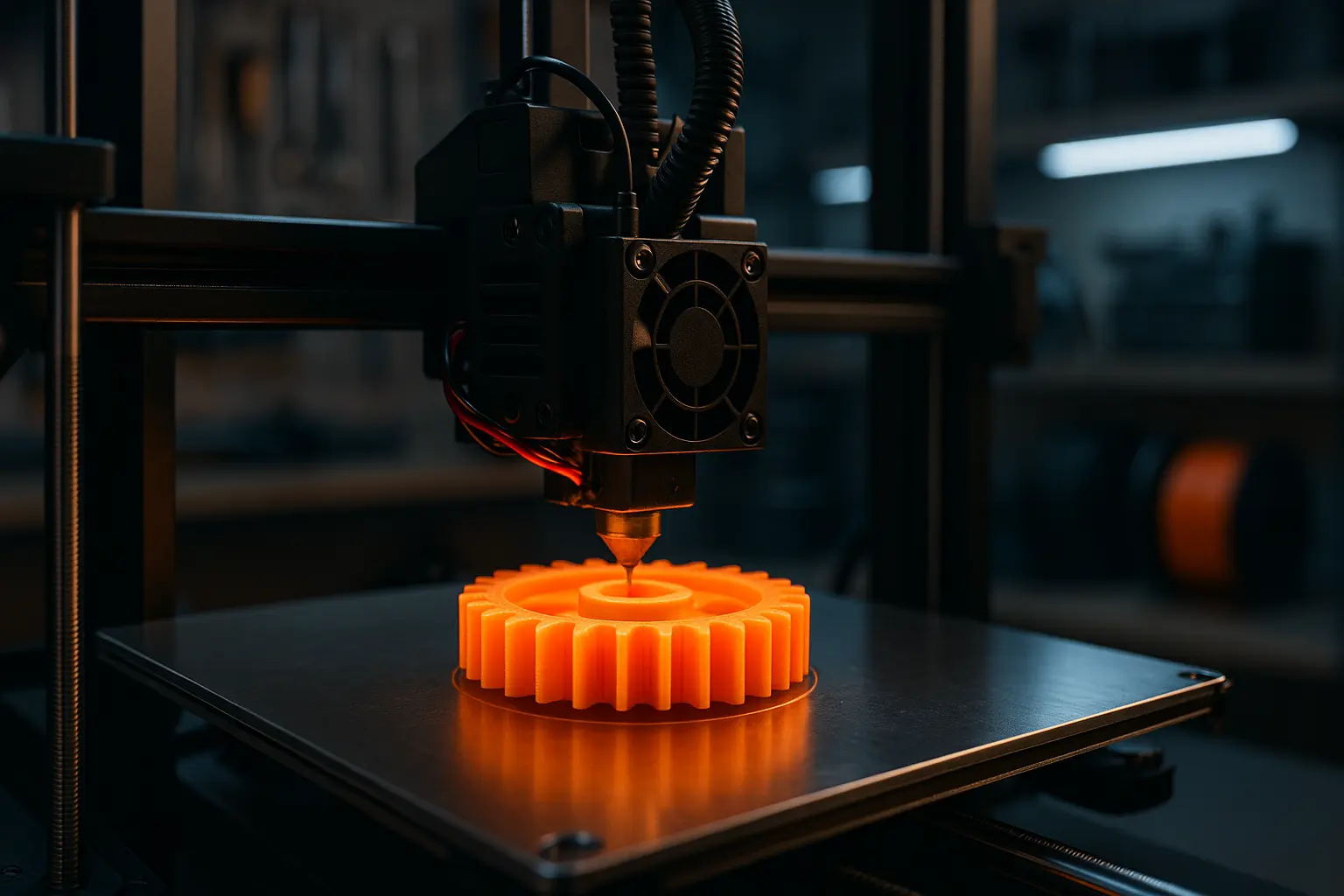
3D Printing Technology
SARITVAT Leading the Way in 3D Printing Technology for Prototyping, Product Design, and Advanced Manufacturing
3D printing—also known as additive manufacturing—is changing the way products are designed, tested, and produced. At SARITVAT, we use the latest 3D printing technologies to turn ideas into real, detailed parts by building them layer by layer. Our focus is not just accuracy but also understanding your goals and helping every team make clear, confident decisions.
Today, 3D printing plays a major role across industries—from product design and rapid prototyping to metal printing in aerospace and healthcare. We also work closely with local teams and nearby vendors whenever it supports better communication, faster action, and smoother project flow. Throughout the process, we stay committed to transparency and ethical practices, keeping people and outcomes at the center.
Our 3D printing capabilities include FDM (Fused Deposition Modeling), SLA (Stereolithography), SLS (Selective Laser Sintering), and a range of advanced metal 3D printing methods. We also specialize in ondemand 3D printing for quick, cost-effective part manufacturing with minimal waste—helping you choose the best approach with clear, easy-to-understand guidance.
SARITVAT’s custom 3D printing services are ideal for low-volume production and fast development cycles. With our 3D printing for prototyping, you can touch and test your concepts long before mass production. The flexibility of modern 3D printing lets us create shapes and features that traditional manufacturing often cannot match—while making sure every decision is practical, balanced, and aligned with your project needs.
Benefits of 3D Printing Technology
Enables rapid prototyping and quick design changes, helping teams understand fit, form, and function without unnecessary stress or delays.
Supports custom 3D printing services tailored to your needs, empowering informed choices that match your goals and values.
Reduces material waste thanks to additive manufacturing methods—helping you meet sustainability targets without compromising performance.
Improves assembly processes with 3D printing-friendly designs that reduce the number of parts and simplify the build.
Gives designers freedom to explore unlimited creative possibilities before committing to expensive tooling.
Boosts production efficiency with ondemand 3D printing, enabling predictable planning and just-in-time delivery.
Offers affordable small-batch metal printing so manufacturers of all sizes can access advanced technology at reasonable cost.
Produces lightweight, durable components with SLS and SLA technologies, ideal for performance-focused applications.
Simplifies workflows by removing traditional tooling requirements, helping you move from concept to production with ease.
Shortens lead times and speeds up time-to-market—supported by reliable quality checks and clear documentation.
Industrial Application and Use Cases
Aerospace: Lightweight, high-strength components made with advanced metal printing and tested for demanding conditions.
Automotive: Functional prototypes and customized parts created through responsive, flexible 3D printing services.
Healthcare: Patient-specific implants and anatomical models crafted with safety, accuracy, and clinical intent in mind.
Product Design: Complex models and iterative prototypes developed in partnership with a trusted supplier network.
Architecture: Highly detailed scale models using SLA technology to bring concepts to life for clearer presentations.
Manufacturing: 3D-printed jigs, fixtures, and production tools designed to support better accuracy and compliance.
Education: Interactive prototyping projects that help students build real-world engineering and problem-solving skills.
Entertainment: Props and intricate models delivered quickly for creative and production needs.
Marine Industry: Corrosion-resistant components designed to perform reliably in challenging environments.
Operations: Streamlined planning and coordination with trusted suppliers for stable and efficient supply chains.
Materials Used in 3D Printing Technology
PLA and ABS Plastics: Popular FDM materials for everyday prototyping with good strength and easy printing.
Photopolymer Resins: Perfect for SLA parts that need precision, clarity, and fine detailing.
Nylon Powders: Used in SLS printing for durable, wear-resistant parts.
Metal Powders: Essential for high-performance metal printing in aerospace and industrial applications.
Advanced Composites: Carbon-fiber reinforced materials for lightweight, high-strength components.
Biocompatible Materials: Ideal for creating safe, medical-grade parts and implants.
Flexible Materials: Great for ergonomic, soft-touch products that mimic rubber-like behavior.
Ceramics: Used for applications in electronics, engineering, and creative arts.
Transparent Resins: Perfect for optical parts and design models where clarity is essential.
Eco-Friendly Materials: Sustainable, biodegradable, or recycled filaments for greener production choices.
How Costing Works
The cost of 3D printing depends on material type, part complexity, quantity, and chosen technology (FDM, SLA, SLS, or metal printing). Ondemand 3D printing helps reduce costs by removing tooling expenses and minimizing waste. At SARITVAT, we make pricing simple and transparent so you always know what you're paying for and why.
For small batches or prototypes, custom 3D printing services offer a budget-friendly alternative to traditional manufacturing. We provide detailed cost breakdowns—including materials, production time, and 3D printing assembly—with engineering support to help you make the right decisions without confusion.
Alternative Technical Suggestions
FDM (Fused Deposition Modeling): Excellent for product design prototypes using strong, reliable thermoplastics.
SLA Printing: Great for high-detail parts with smooth surfaces and clean finishes.
SLS Printing: Perfect for durable, functional components without the need for support structures.
Metal Printing (DMLS, SLM): Advanced methods for producing precise, high-strength metal components.
Multi Jet Fusion (MJF): Ideal for fast production of tough nylon parts at scale.
PolyJet Printing: Best for colorful, multi-material prototypes that clearly communicate design intent.
Electron Beam Melting (EBM): High-performance metal printing for medical and aerospace applications.
Digital Light Processing (DLP): A fast and economical option for intricate resin-based parts.
Hybrid Manufacturing: Combines 3D printing with CNC machining to achieve tight tolerances and excellent finishes.
Binder Jetting: A cost-effective solution for low-volume metal parts with easy post-processing.
FAQs
Q: What is 3D Printing
Technology?
A: 3D printing, or
additive manufacturing, creates
three-dimensional objects by stacking material
layer by layer. It’s fast, efficient, and great
for quick learning and testing cycles.
Q: How does 3D Printing benefit rapid
prototyping?
A: It helps
validate ideas quickly, reduces development
time, and lets teams align on design decisions
with real, physical models.
Q: What is the difference between SLA and
SLS Printing?
A: SLA cures
liquid resin using a laser for high detail,
while SLS uses heat to fuse powder into strong,
functional parts.
Q: What industries benefit from Custom 3D
Printing Services?
A: Aerospace,
automotive, healthcare, architecture, consumer
products, and many more rely on 3D printing for
specialized solutions with clear documentation.
Q: How does SARITVAT ensure the quality
of Metal Printing?
A: We use
advanced technologies like DMLS and SLM, with
strict process controls to ensure strength,
precision, and consistency.
Q: Can OnDemand 3D Printing reduce
manufacturing costs?
A:
Absolutely. It cuts down tooling costs, supports
flexible production, and makes budgeting easier.
Q: What are the advantages of 3D Printing
Assembly at SARITVAT?
A: We
streamline multi-part assemblies by integrating
complex geometries, reducing assembly time, and
improving performance.
Q: What materials are commonly used in
Additive Manufacturing?
A: A
variety of materials including plastics, resins,
metal powders, composites, and medical-grade
materials—selected based on your project needs.
Q: How does SARITVAT support sustainable
manufacturing?
A: By reducing
waste, offering eco-friendly materials, and
working with trusted suppliers for
responsible sourcing practices.
Q: What countries does SARITVAT serve for
3D Printing Technology?
A: Asia:
India, Japan, South Korea, Indonesia, Vietnam,
Thailand, Malaysia, Taiwan, Singapore,
Philippines, Bangladesh
Europe: Germany, UK,
France, Italy, Netherlands, Spain, Poland,
Belgium, Switzerland, Sweden, Austria, Czech
Republic
South America: Brazil, Argentina,
Chile, Colombia, Peru
Middle East: Saudi
Arabia, UAE, Turkey, Israel, Qatar,
Kuwait
Africa: South Africa, Nigeria, Egypt,
Morocco, Kenya, Ethiopia
Oceania: Australia,
New Zealand
North America: USA, Mexico,
Canada
Q: What are the estimated global shipping
times?
A: SEA: Asia: 15–20 days,
Europe: 25–35 days, North America: 30–40 days,
South America: 35–45 days, Middle East: 14–18
days, Africa: 20–28 days, Oceania: 22–30
days
AIR: Asia: 1–3 days, Europe: 3–5 days,
North America: 4–6 days, South America: 5–7
days, Middle East: 1–2 days, Africa: 3–5 days,
Oceania: 4–6 days